Introduction: The End of Screen-Bound Intelligence
Artificial intelligence has reached an inflection point that is easy to miss if one focuses only on model benchmarks, parameter counts, or leaderboard performance. For the past several years, progress in AI has been framed almost entirely in terms of output quality: how fluent the text is, how realistic the images appear, how coherent long-form reasoning has become. These advances are real and impressive, but they obscure a more fundamental transition now underway. The most important shift in AI is not about what models can generate, but about where AI operates, how it perceives the world, and how directly it integrates into human cognition.
Historically, AI systems have lived behind screens. They have been tools we consult intentionally, systems we query explicitly, or engines we invoke when we know we need help. Even the most advanced large language models today still follow this basic pattern. A human pauses their primary task, opens an interface, formulates a prompt, and waits for a response. This interaction model places AI outside the natural flow of human perception and action.
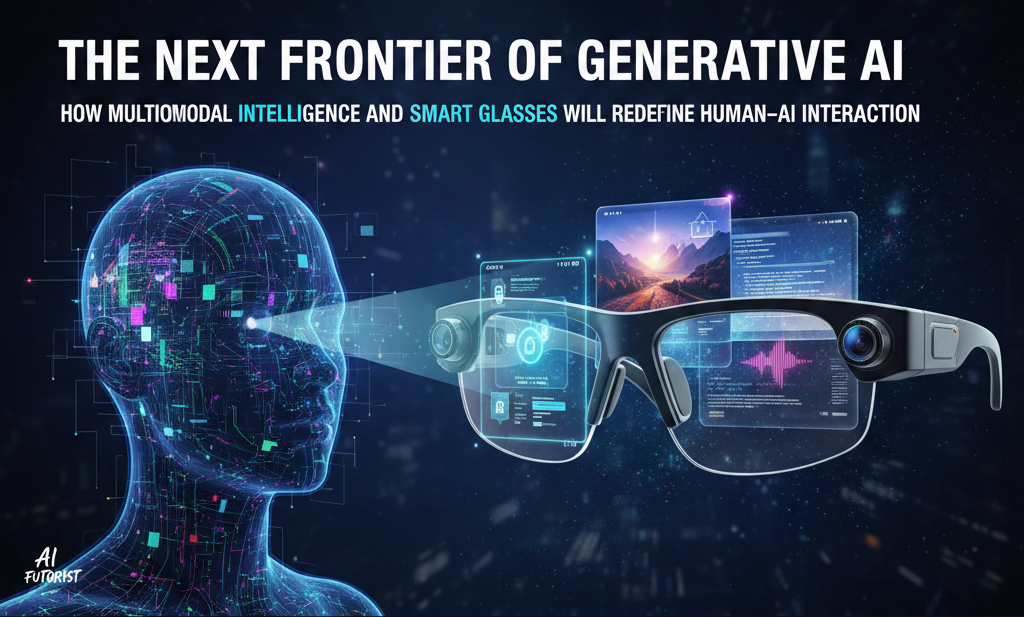
The next wave of AI breaks this pattern entirely. It is driven by two technological trends that are developing rapidly and largely independently, yet whose convergence is inevitable. The first is the rise of multimodal generative AI capable of operating in real-time streaming mode, pioneered most visibly by Google through Google AI Studio and the Gemini model family, including native video understanding. The second is the emergence of smart glasses as a viable, always-on computing interface, pioneered most prominently by Meta, that provides continuous first-person visual access to the physical world with minimal cognitive friction.
Individually, these trends represent meaningful advances. Together, they redefine what AI is and how it functions. When multimodal AI systems can continuously process visual, auditory, and textual signals from a human’s point of view, and when that intelligence is delivered through a device that does not demand attention or manual interaction, AI stops being an application and becomes ambient intelligence. It becomes a cognitive layer that coexists with perception itself.
This article argues that the integration of multimodal, streaming generative AI with smart glasses will define the next major AI revolution. It explains why this convergence matters, what new capabilities it unlocks, how it reshapes human–AI interaction across multiple domains, and why the companies that succeed in delivering a reliable, trusted implementation will gain an outsized strategic advantage in the global AI race.
The First Trend: Multimodal AI and the Transition from Discrete to Continuous Intelligence
To understand why this moment is different, it is necessary to examine how AI systems have historically interacted with the world. Most machine learning systems, including early deep learning models and even many modern large language models, are fundamentally batch-oriented. They take a bounded input, perform computation, and return an output. Even when these systems appear conversational, the underlying interaction is still discrete. Each turn is processed largely in isolation, with limited persistent awareness of a changing external environment.
Multimodal AI began to challenge this constraint by expanding the types of inputs models could accept. Images, audio, and eventually video were added alongside text, enabling richer forms of understanding. However, in early implementations, multimodality often meant little more than concatenation: different encoders feeding into a shared model without deep temporal integration. Video was treated as a sequence of frames, audio as a clip, and context as something static.
What has changed with systems like Gemini is not merely the inclusion of more modalities, but the native treatment of time and continuity. Video is no longer just a set of images; it is motion, causality, and progression. Audio is not a recorded file; it is an unfolding signal. Text is no longer the primary medium but one of several coequal channels.
Most importantly, these models are increasingly capable of operating in streaming mode, ingesting data continuously rather than waiting for complete inputs. This seemingly technical distinction has profound implications. A streaming multimodal model can observe, update its internal state, and revise its understanding moment by moment. It can notice change, detect anomalies as they emerge, and maintain situational context over extended periods.
This capability brings AI closer to how humans perceive the world. Human cognition is not based on isolated snapshots. It is continuous, predictive, and context-aware. We do not wait for a scene to end before interpreting it; we interpret as it unfolds. Streaming multimodal AI enables machines to do the same.
The significance of this shift cannot be overstated. Once AI can perceive the world continuously, it becomes possible for it to participate meaningfully in real-world tasks that unfold over time, rather than merely reacting to completed events. This is the foundation upon which all subsequent use cases rest.
The Second Trend: Smart Glasses and the Re-Emergence of First-Person Computing
While multimodal AI has been evolving on the software side, a parallel transformation has been occurring in hardware and interfaces. For over a decade, the smartphone has been the dominant personal computing device. Its success reshaped entire industries, but it also imposed a specific interaction model: touch, screens, and deliberate engagement. This model is ill-suited for continuous, ambient intelligence.
Smart glasses represent a return to an older but more natural idea: computing that aligns with human perception rather than interrupting it. Instead of requiring a user to look down at a screen, glasses operate in the same visual field as the world itself. Instead of demanding manual input, they rely on passive sensing and minimal gestures or voice interaction.
Meta’s work on smart glasses highlights a critical insight that is often misunderstood. The most valuable feature of these devices is not the display, the speakers, or even the aesthetics. It is the camera positioned at eye level, capturing the world exactly as the user sees it. This creates a stream of visual data that is uniquely aligned with human attention.
A first-person camera captures not just objects, but intent. What the user looks at, how long they look, and in what sequence provides implicit signals about relevance, curiosity, uncertainty, or concern. This makes the data far more informative than third-person video feeds, which require significant inference to determine what matters.
From an AI perspective, this alignment is transformative. One of the hardest problems in perception is determining salience: deciding which parts of a scene deserve attention. First-person visual data solves much of this problem by definition. The human’s gaze acts as a natural attention filter.
Smart glasses therefore do not merely collect data; they encode human context directly into the sensory stream. This is what makes them the ideal interface for ambient AI.
Where the Breakthrough Happens: Merging Streaming Multimodal AI with Smart Glasses
When these two trends converge, AI crosses a threshold. It stops being something that humans operate and becomes something that operates alongside humans. The AI sees what the human sees, hears what the human hears, and processes this information continuously. It does not wait for explicit commands. It observes, interprets, and prepares to assist when needed.
This fundamentally changes the human–AI relationship. Instead of humans adapting their behavior to fit AI interfaces, AI adapts to human perception and workflows. Assistance becomes contextual rather than requested, proactive rather than reactive, and situational rather than generic.
Importantly, this does not imply autonomy in the sense of replacing human decision-making. In most high-value scenarios, full autonomy is neither desirable nor safe. What this integration enables is cognitive augmentation. The AI becomes a second set of eyes, an auxiliary memory, and a pattern detector that never tires.
The remainder of this article explores what this looks like in practice.
Use Case One: Cognitive Oversight in High-Stakes Environments
The term “quality assurance” is insufficient to describe the first major class of use cases unlocked by AI-enabled smart glasses. What is really at stake is cognitive oversight: the continuous monitoring of complex environments where failure is costly and attention is fragile.
Consider aviation, industrial manufacturing, energy infrastructure, or logistics operations. In these settings, automation handles many structured tasks, but humans remain responsible for monitoring unstructured aspects of the environment. A pilot must notice anomalies outside the cockpit instruments. A factory worker must detect subtle changes in sound, vibration, or appearance that indicate a problem. A technician must ensure that physical configurations match procedural requirements.
These tasks place a heavy burden on human attention. Decades of research in human factors engineering show that vigilance degrades over time, especially in environments that are mostly stable but occasionally dangerous. Humans are particularly bad at detecting rare events precisely because they are rare.
Smart glasses integrated with streaming multimodal AI provide a solution that does not rely on replacing humans with automation. Instead, the AI acts as a continuous observer that never fatigues. By processing the first-person visual stream, the AI can learn what “normal” looks like in a given context and flag deviations when they occur.
For example, in a manufacturing setting, the AI can notice a missing safety guard, an improperly positioned component, or an unusual wear pattern on equipment. In aviation, it can detect foreign objects, visual obstructions, or configuration mismatches. The AI does not need to understand everything; it only needs to notice when something deviates from expected patterns and bring it to human attention.
The key benefit here is cognitive load reduction. The human no longer needs to actively monitor every detail. Instead, they can focus on primary tasks, trusting the AI to alert them when something warrants attention. This reduces errors, improves safety, and enhances overall system reliability.
Use Case Two: Live Translation and Environmental Understanding
Language barriers are one of the most common sources of friction and uncertainty in unfamiliar environments. While translation apps exist, they require explicit action: opening a phone, pointing a camera, or typing text. This interaction model breaks immersion and increases cognitive load at precisely the moments when attention is most valuable.
Smart glasses change this dynamic entirely. When combined with multimodal AI, they enable translation to occur as part of perception itself. Road signs, product labels, instructions, and warnings can be translated automatically as they enter the user’s field of view.
More importantly, the AI can use context to determine what needs translation. Not every piece of text in the environment is relevant. By aligning translation with gaze and situational cues, the system avoids overwhelming the user with unnecessary information.
This capability has profound implications for navigation, safety, and decision-making. A driver in a foreign country can understand road signs without diverting attention. A traveler can assess food ingredients instantly. A worker can follow instructions without misunderstanding critical details.
In each case, the AI reduces uncertainty at the moment it matters most: when the decision is being made, not after the fact.
Use Case Three: AI-Augmented Real Estate and Environmental Evaluation
Real estate is an industry defined by high financial stakes, asymmetric information, and constrained decision windows. Buyers are often expected to make judgments involving hundreds of thousands or millions of dollars after spending only a short amount of time physically inside a property. Even experienced buyers lack the technical expertise to reliably detect many categories of issues, while first-time buyers are particularly vulnerable to missing important signals entirely.
Traditionally, this gap is addressed through professional inspections, disclosures, and post-offer due diligence. While these mechanisms are essential, they occur late in the process and are often constrained by time pressure and emotional commitment. What is missing is early-stage perceptual augmentation—the ability to notice, contextualize, and remember important environmental details during the initial walkthrough itself.
Smart glasses integrated with multimodal AI fundamentally change what a “home tour” can be.
As a buyer walks through a property wearing AI-enabled glasses, the system continuously analyzes the visual stream. Because the AI has access to first-person perspective, it understands which features the buyer is examining and for how long. This allows it to surface insights selectively rather than overwhelming the user with constant commentary.
Structural issues are an obvious starting point. Hairline cracks, uneven surfaces, door misalignments, or subtle wall deformations are often dismissed as cosmetic, yet they can indicate foundational movement or long-term stress. A multimodal AI system trained on large corpora of structural imagery can flag such patterns in real time, distinguishing between benign imperfections and potential red flags that merit further inspection.
Environmental quality is another critical dimension. Lighting conditions, for example, are difficult to evaluate during short visits, especially if the time of day is not representative. AI can assess light distribution, identify shadow-heavy zones, and estimate how natural light will shift based on orientation and window placement. Similarly, ventilation quality can be inferred from vent placement, room geometry, and airflow indicators, helping buyers understand comfort implications that are not immediately obvious.
Moisture and water damage present a particularly compelling use case. Subtle discoloration, texture changes, or material warping often go unnoticed by untrained observers. AI systems that have been trained to recognize early indicators of moisture intrusion can surface these signals instantly, enabling buyers to ask informed questions before progressing further.
Importantly, this is not about replacing professional inspectors or generating definitive judgments. The value lies in attention guidance. The AI helps buyers notice what they might otherwise miss, improving the quality of early decision-making and reducing downstream regret.
Over time, as such systems become widespread, they could reshape market dynamics by reducing information asymmetry and raising baseline expectations for transparency.
Use Case Four: Skilled Labor, Field Service, and the Industrial Knowledge Gap
Across industries such as manufacturing, utilities, telecommunications, and heavy equipment maintenance, organizations face a growing shortage of skilled labor. Experienced technicians are retiring faster than they can be replaced, and much of their expertise exists as tacit knowledge rather than formal documentation. Training new workers is time-consuming, expensive, and error-prone.
This problem is not fundamentally about access to information. Manuals, schematics, and procedures often exist. The challenge lies in contextual application. Knowing what to do is different from knowing what to do here, now, on this specific machine, under these conditions.
Smart glasses paired with multimodal AI address this gap by embedding expertise directly into the field of view of the worker. As a technician approaches a piece of equipment, the AI can recognize the model, identify components, and recall relevant service history. As the worker begins a task, the AI can observe each step, compare it against known procedures, and provide guidance or correction in real time.
Crucially, this guidance does not need to be intrusive. In many cases, subtle confirmation—such as indicating that a step has been completed correctly—is sufficient. When deviations occur, the AI can flag them immediately, preventing small mistakes from cascading into larger failures.
This capability effectively turns AI into a real-time mentor, scaling expertise without requiring constant human supervision. Junior technicians can perform more complex tasks sooner, while experienced workers benefit from reduced cognitive load and fewer oversights.
From an organizational perspective, this has profound implications. Training timelines shorten, error rates decrease, and institutional knowledge becomes more resilient to workforce turnover. Over time, the data collected from these interactions—always subject to privacy and governance constraints—can further improve both AI performance and procedural design.
Use Case Five: Healthcare, Clinical Support, and Professional Training
Healthcare environments are among the most cognitively demanding settings humans operate in. Clinicians must integrate visual observations, patient histories, procedural protocols, and time-sensitive decisions under constant pressure. Errors, when they occur, are often the result of overload rather than incompetence.
AI-enabled smart glasses offer a path toward assistive intelligence that supports clinicians without undermining their authority or judgment.
In clinical examinations, for example, subtle visual cues can be difficult to interpret consistently. Changes in skin coloration, wound healing progression, or physical symmetry may signal underlying issues, but they require experience to recognize reliably. A multimodal AI system trained on large, diverse medical datasets can highlight anomalies in real time, providing a second opinion that augments, rather than replaces, the clinician’s assessment.
In procedural contexts, smart glasses can serve as a silent checklist. By observing the procedure as it unfolds, the AI can track whether required steps have been completed in the correct sequence. If a step is skipped or performed incorrectly, the system can alert the clinician immediately, reducing the likelihood of preventable errors.
Training and education represent another powerful application. Medical students and residents learn best through guided practice, yet supervision resources are limited. AI-enabled glasses allow trainees to receive real-time feedback while performing procedures, accelerating skill acquisition and improving consistency. Supervisors, in turn, can review annotated recordings to provide targeted guidance.
As with other domains, the central value lies in reducing cognitive burden and increasing situational awareness. The AI does not make decisions; it enhances perception and memory, allowing clinicians to focus more fully on patient care.
The Human Factor: Attention, Cognition, and Why This Matters
To fully appreciate why the convergence of multimodal AI and smart glasses is transformative, it is necessary to examine the problem it addresses at a deeper level. At its core, this technology targets the limits of human cognition.
Human attention is selective, finite, and fragile. We are good at focusing deeply on one task, but poor at monitoring many signals simultaneously. We are adept at pattern recognition, yet prone to missing anomalies when cognitive load is high. These limitations are not flaws; they are trade-offs shaped by evolution.
Modern environments, however, increasingly exceed these limits. We ask humans to operate complex systems, interpret dense information, and maintain vigilance over extended periods. The result is predictable: fatigue, errors, and incidents.
Traditional automation attempts to solve this by removing humans from the loop. In some cases, this works. In many others, it introduces new failure modes, particularly when systems encounter conditions they were not designed to handle.
The approach enabled by AI-integrated smart glasses is fundamentally different. Instead of replacing human cognition, it extends it. The AI handles continuous monitoring, pattern detection, and recall, while the human retains judgment, context, and responsibility.
This division of labor aligns closely with what humans and machines each do best. Machines excel at tireless observation and consistency. Humans excel at interpretation, values, and decision-making under uncertainty.
By embedding AI into perception itself, we reduce the need for humans to consciously manage attention. The result is not faster work, but safer, more reliable work.
Technical Realities: Constraints That Will Shape Adoption
Despite the promise of this paradigm, delivering a reliable, real-world implementation is extremely challenging. Several technical constraints will determine whether this vision succeeds or fails.
Latency is paramount. For AI assistance to be useful in perceptual tasks, responses must occur within tens of milliseconds. Delays break the illusion of continuity and can even create safety risks. Achieving this requires careful balancing between on-device processing and cloud-based inference.
Power and thermal constraints present another major challenge. Smart glasses have limited battery capacity and heat dissipation. Running large models entirely on-device is often impractical, yet relying too heavily on cloud inference introduces latency and connectivity dependencies. Hybrid architectures, where lightweight perception runs locally and heavier reasoning occurs in the cloud, are likely to dominate.
Accuracy and trust are equally critical. In perceptual systems, false positives are particularly damaging. If an AI system frequently flags non-issues, users will quickly learn to ignore it. Designing conservative, confidence-aware prompting strategies is essential. In many cases, it is better for the AI to remain silent than to speak incorrectly.
Finally, robustness matters. Real-world environments are messy. Lighting changes, occlusions occur, sensors fail, and conditions vary widely. Systems must degrade gracefully, providing partial assistance rather than collapsing entirely when inputs are imperfect.
These challenges mean that success in this space is not merely a function of model quality. It requires end-to-end system excellence, from hardware design to model architecture to user experience.
Privacy, Ethics, and Social Acceptance
No discussion of always-on, perception-based AI is complete without addressing privacy and ethics. Smart glasses that continuously capture first-person visual data raise legitimate concerns about surveillance, consent, and misuse.
For users, trust depends on clear guarantees about data handling. Systems must minimize data retention, perform as much processing as possible locally, and provide transparent controls over what is recorded, stored, or shared. Users must understand when AI is active and how their data is being used.
For bystanders, social acceptance hinges on norms and safeguards. Visual indicators of recording, strict limitations on facial recognition, and contextual awareness of sensitive environments are all critical. Without these measures, backlash is inevitable.
Ethical design is not a secondary concern in this domain; it is a prerequisite for adoption. Companies that fail to address these issues proactively will struggle to earn trust, regardless of technical sophistication.
Competitive Dynamics: Why This Is the Next AI Battleground
As foundation models continue to improve, they are rapidly commoditizing. Performance differences that once mattered greatly are narrowing, and open-source alternatives are becoming increasingly capable. In this environment, sustainable advantage shifts away from models themselves and toward systems, integration, and distribution.
The convergence of multimodal AI and smart glasses represents a new battleground precisely because it is hard. It requires expertise across:
- Large-scale model development
- Real-time inference infrastructure
- Custom hardware and sensors
- Human-centered design
- Privacy and policy frameworks
Few organizations possess strength across all of these dimensions. Those that do are uniquely positioned to define the platform.
First movers in this space benefit from powerful data flywheels. First-person, context-rich data is extremely valuable for improving perceptual models, yet difficult for competitors to replicate without similar distribution. Over time, this creates a compounding advantage.
Moreover, once users integrate such systems into daily workflows, switching costs become significant. Ambient intelligence that supports perception and decision-making becomes deeply embedded, making it harder for alternatives to displace.
Conclusion: From Artificial Intelligence to Ambient Intelligence
The next revolution in generative AI will not be measured in parameters or benchmarks. It will be measured in how seamlessly intelligence integrates into human life.
By combining streaming multimodal AI with smart glasses, we move toward a world where AI is no longer something we consult, but something that quietly supports us as we perceive, decide, and act. This shift does not diminish human agency; it enhances it. It allows humans to operate complex systems more safely, navigate unfamiliar environments more confidently, and learn new skills more effectively.
The technology to make this possible is emerging now. The remaining challenges lie in execution, trust, and design. The organizations that succeed will not merely build better AI models. They will build the cognitive infrastructure of the physical world.
That is where the next AI revolution will occur.
